If you are selling online in Bangladesh, you have probably wondered: should I set up bKash, Nagad, or both?
The honest answer is both. But understanding why means looking at how these two wallets actually differ — in user base, transaction behaviour, and checkout preference. That context changes how you think about your payment setup and why dropping either one costs you real sales.
bKash: The Market Leader
bKash launched in 2011 and has had over a decade to build habits. The numbers reflect it.
As of 2025, bKash has over 65 million registered accounts and processes more than 10 million transactions per day. It is deeply embedded in how Bangladeshis think about mobile money — for many users, "mobile banking" and "bKash" are the same word.
In ecommerce specifically, bKash dominates urban and semi-urban customers. If your buyers are in Dhaka, Chittagong, Sylhet, or other major cities, there is a very high probability they have a bKash account and use it regularly.
bKash strengths for merchants:
- Widest user base - higher checkout completion for urban buyers
- Strong brand trust built over 14+ years
- Tokenized Checkout API well-documented and stable
- Familiar to most courier and logistics partners
bKash limitations:
- Higher transaction fees compared to Nagad
- Agent network more concentrated in urban areas
- Less competitive among younger rural users
Nagad: Growing Fast and Closing the Gap
Nagad launched in 2019 — eight years after bKash — but it has grown aggressively. By 2025 it has crossed 90 million registered accounts, overtaking bKash in registered users even if transaction volume still lags.
The reason for that growth is a combination of government backing (Nagad is operated under Bangladesh Post Office), lower transaction fees, and heavy rural penetration. In districts outside the major cities, many customers who have Nagad do not have bKash - or vice versa.
Nagad strengths for merchants:
- Lower merchant transaction fees than bKash
- Stronger penetration in rural and semi-urban areas
- Fast-growing user base, especially among younger demographics
- Strong cashback and offer ecosystem that drives customer preference
Nagad limitations:
- Slightly lower urban checkout familiarity compared to bKash
- API documentation less established than bKash's mature ecosystem
- Smaller but growing history of ecommerce integrations
Who Uses Which at Checkout?
Here is the pattern BD Wallet merchants tend to see across Shopify stores in Bangladesh:
| Customer Segment | Likely Preference |
|---|---|
| Dhaka / urban shoppers | bKash first, Nagad if bKash unavailable |
| Rural / semi-urban shoppers | Nagad first, bKash as fallback |
| 18–30 age group | Split roughly even, Nagad trending |
| 35+ age group | bKash dominant |
| Repeat buyers | Whichever wallet they registered first |
The pattern is clear: there is no single winner. Different customers have different wallets as their primary, and if your store only supports one, you are invisible to a meaningful segment of your buyers.
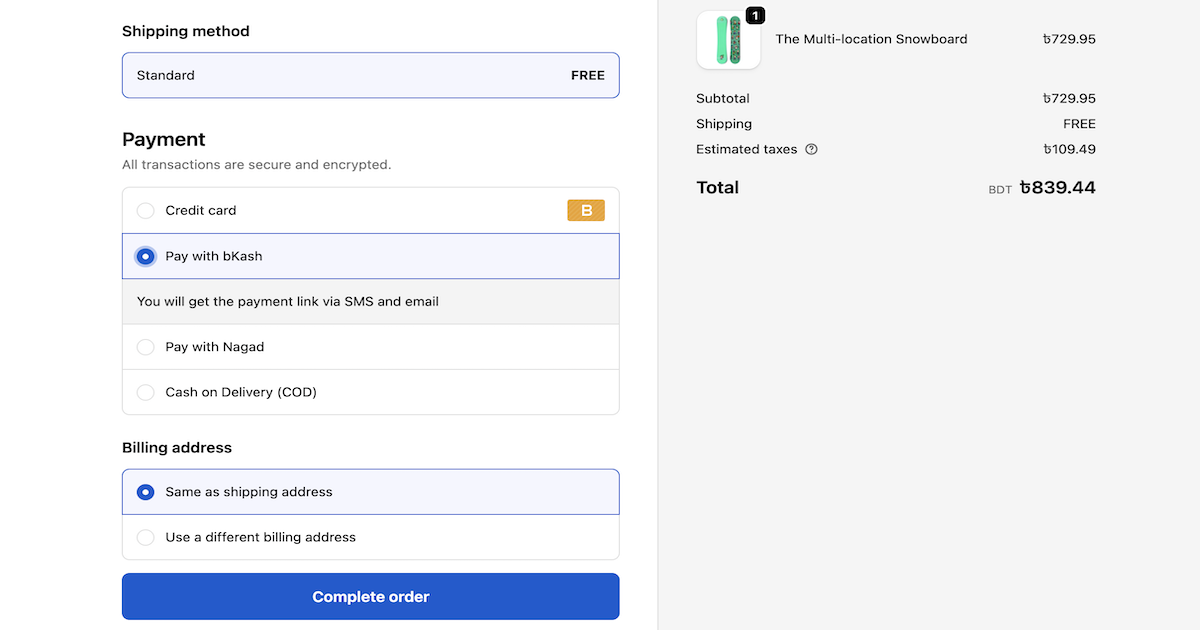
Both gateways available at checkout - customers pick whichever wallet they use
The Cost of Offering Only One
Imagine a customer in Rajshahi who uses Nagad. They visit your Shopify store, pick a product, reach checkout, and see only bKash. They either abandon the order or — if they are motivated enough — open their bKash app, create an account, load money, and come back.
Most do not come back. They go to your competitor who supports Nagad.
The same happens in reverse for a Dhaka customer who uses bKash on a store that only supports Nagad.
In a market where COD is the fallback for every unsupported payment method, every checkout without a wallet option is either a lost sale or a COD order with a higher return risk.
What BD Wallet Does Differently
Most payment solutions force you to choose. BD Wallet supports both bKash and Nagad simultaneously on the same Shopify store.
When a customer receives their payment link, they see both options and pick the one they use. No friction, no account switching, no dropped orders because you only support one gateway.
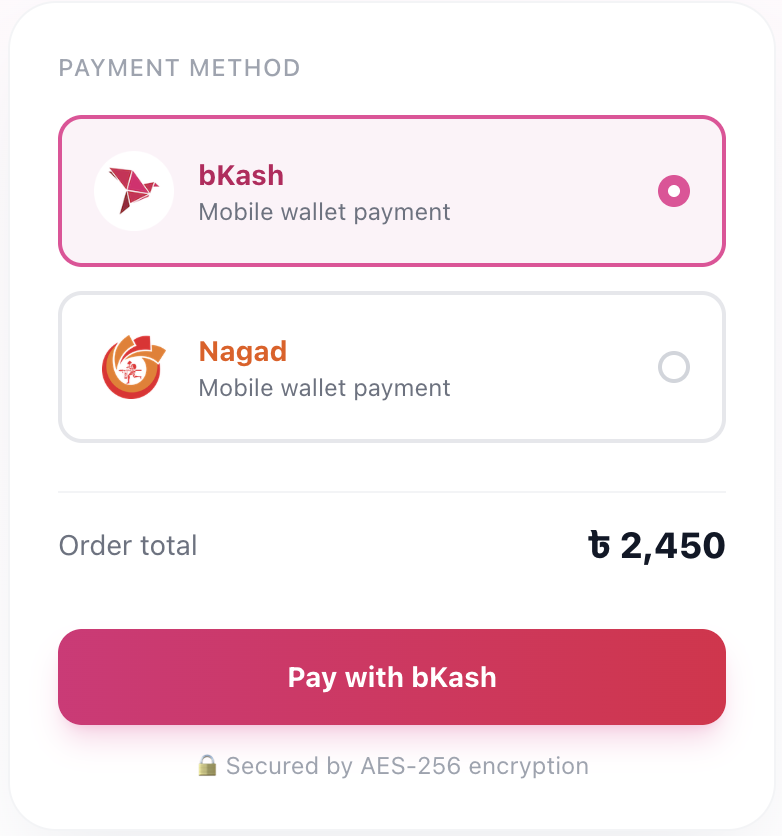
The BD Wallet payment link gives customers the choice - bKash or Nagad, whichever they prefer
Both gateways run through the same dashboard. Every transaction — bKash or Nagad — appears in one place. Your analytics show you which wallet your customers actually prefer so you can make informed decisions about where to focus offers or promotions.
Setting Up Both Gateways
Inside BD Wallet, adding both gateways is two separate credential inputs:
bKash: Go to Settings → bKash → enter App Key, App Secret, Username, Password → Save → toggle Active
Nagad: Go to Settings → Nagad → enter Merchant ID and credentials → Save → toggle Active
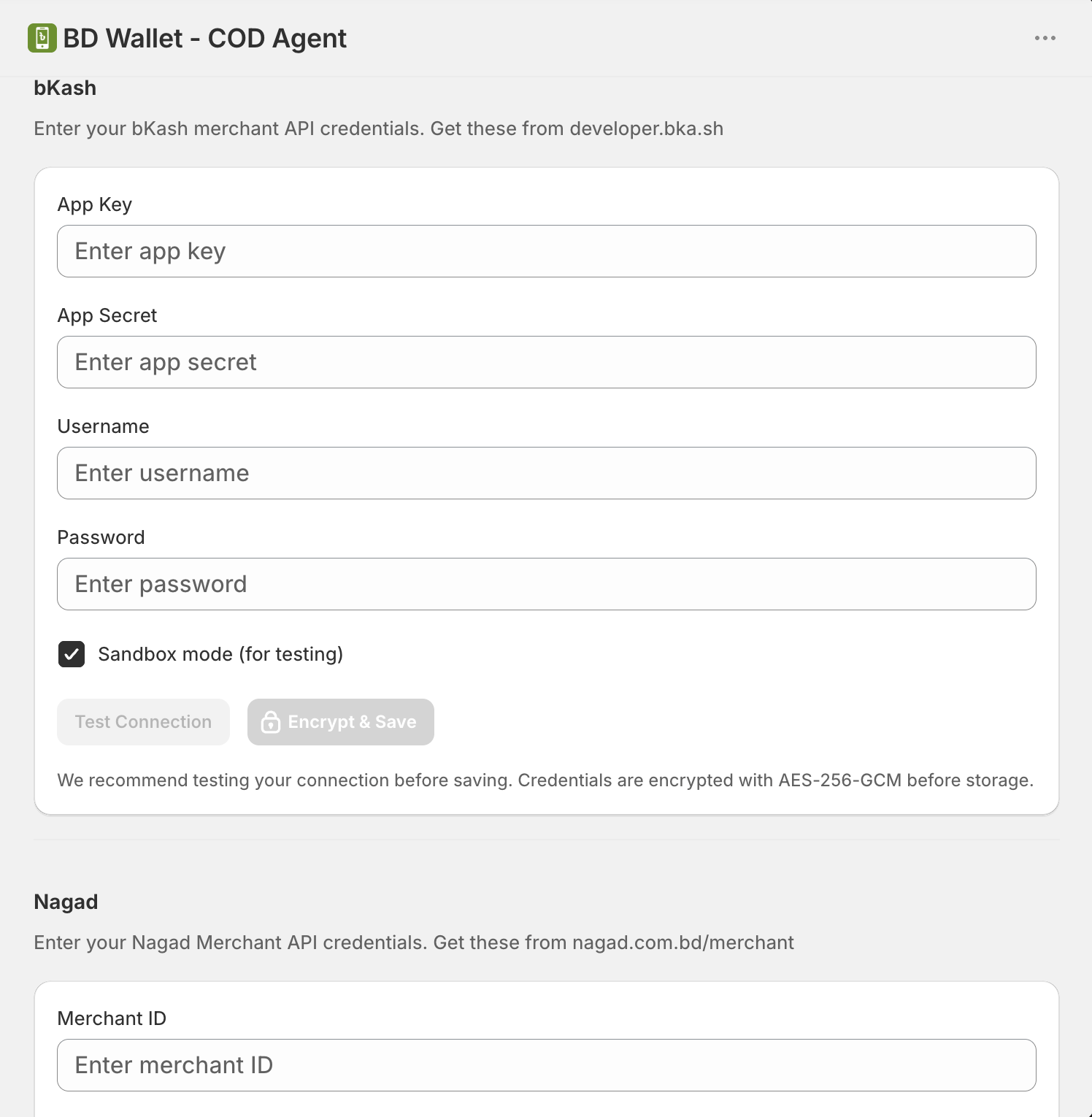
Both gateways configured from the same settings screen - independent credentials, one unified dashboard
Both gateways are independent. If one is unavailable or you have not yet received merchant approval for one, you can run the other in the meantime.
Which Gateway Has Lower Fees?
Nagad's merchant transaction fees are generally lower than bKash's. The exact rates depend on your merchant agreement, but Nagad consistently offers more competitive pricing — especially for higher-volume stores.
If you are processing significant volume and want to reduce payment costs, you can track which gateway your customers use via BD Wallet's analytics and run promotions nudging them toward Nagad where it makes financial sense.
The Practical Answer
Stop treating this as a choice. In Bangladesh's ecommerce market in 2025:
- bKash gives you the widest urban reach and the most established trust
- Nagad gives you rural coverage, lower fees, and a fast-growing user base
- Offering both means no customer has a reason to leave your checkout
The question is not bKash or Nagad. The question is how quickly you can get both live on your store.
Frequently Asked Questions
Can I run bKash and Nagad on the same Shopify store?
Yes. BD Wallet supports both simultaneously. Customers see both options when they receive a payment link and choose whichever wallet they use.
Which wallet has more users in Bangladesh?
Nagad has more registered accounts (90M+) but bKash has higher daily transaction volume and deeper ecommerce usage as of 2025.
Are bKash merchant fees higher than Nagad?
Generally yes. Nagad offers lower transaction fees for merchants, though exact rates depend on your individual merchant agreement with each provider.
Do I need separate merchant accounts for bKash and Nagad?
Yes. You need a bKash Tokenized Checkout account approved by bKash, and a separate Nagad merchant account approved by Nagad. BD Wallet connects to both using the credentials each provider gives you.
What if my customers are mostly in rural areas?
Nagad has stronger rural penetration. If your customer base is mostly outside major cities, prioritise getting your Nagad merchant account set up first while bKash approval is in progress.
Can I see which gateway my customers prefer in BD Wallet?
Yes. The BD Wallet analytics dashboard shows payment breakdown by gateway so you can see exactly how your customers split between bKash and Nagad.
Stop Leaving Half Your Customers Without a Payment Option
Your customers have already decided which wallet they use. They are not going to switch for your checkout page.
Offering both bKash and Nagad means every customer - urban or rural, young or old, Dhaka or Dinajpur - has a payment option that works for them.
Install BD Wallet free on Shopify and accept bKash and Nagad on your store today.
Tagged:
Ready to accept bKash and Nagad on your Shopify store?
Free plan available. No developer needed. Set up in 10 minutes.
Get Started Free